Are Dental X-Rays Safe? Radiation, Risks and What You Need to Know

Dr Tristan Tinn
Founder & Clinical Director
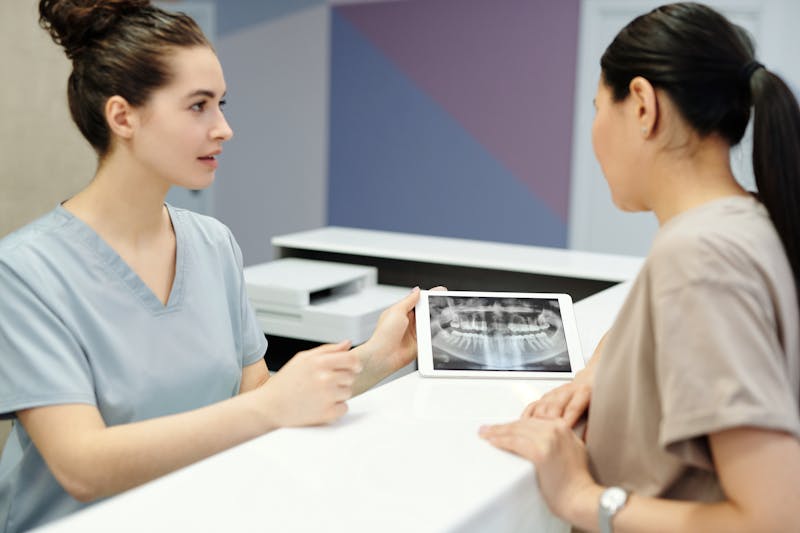
It is a question many patients ask: "Is it really necessary to have an X-ray?" and "How safe are they?" The short answer is that dental X-rays involve an extremely small amount of radiation. Far less than many everyday exposures you may not even think about. Here is a detailed look at what the science actually says.
Key Takeaways
- •A single dental X-ray delivers about 0.005 mSv of radiation. Less than a day of natural background radiation
- •You would need thousands of dental X-rays to approach levels that increase health risk
- •Dental X-rays detect hidden decay, bone loss, infections, and cysts that cannot be seen clinically
- •Modern digital X-rays use up to 80% less radiation than older film-based systems
- •Dental X-rays are safe during pregnancy when clinically necessary, with a lead apron for precaution
- •Skipping X-rays can mean missing problems until they become painful and expensive to treat
How Much Radiation Are We Talking About?
Radiation doses are measured in millisieverts (mSv). To put dental X-rays into perspective, here is how they compare to other common exposures:
Radiation comparison chart:
- Dental bitewing X-ray (single): 0.005 mSv
- Dental panoramic X-ray (OPG): 0.01 mSv
- Flight from London to Spain: 0.02 mSv
- Chest X-ray: 0.02 mSv
- UK average annual background radiation: 2.2 mSv
- CT scan of the head: 1.4 mSv
A single dental bitewing produces roughly a quarter of the radiation you would receive on a short-haul flight — and about 440 times less than your annual background exposure from natural sources like radon gas, cosmic rays, and the food you eat.
Due for a check-up and X-rays? Search for dentists with availability near you.
Modern Digital X-Rays: Even Lower Doses
If your practice still used old-fashioned film X-rays, the doses above would be somewhat higher. The good news is that the vast majority of UK dental practices now use digital X-ray sensors, which require up to 80% less radiation than traditional film to produce a clear image.
Digital X-rays also offer additional advantages: the images appear instantly on screen (no waiting for film to develop), they can be enhanced and zoomed for better diagnosis, and they are easier to store and share securely. If your practice has not yet gone digital, it may be worth asking about it at your next visit.
Why Does the Dentist Leave the Room?
This is the question that makes many patients nervous: "If it is so safe, why do you leave the room?" The answer is straightforward and has nothing to do with the risk to you as a patient.
A patient might have one or two X-rays at a visit, perhaps a few times a year. A busy dentist, however, may take dozens of X-rays every single day, five days a week, for an entire career spanning 30 or 40 years. While the dose from each individual X-ray is negligible, the cumulative exposure from standing next to hundreds of thousands of X-rays over a career would add up. Leaving the room is a sensible precaution to keep occupational exposure as low as reasonably achievable — a principle known as ALARA.
When Are Dental X-Rays Needed?
Dentists in the UK follow guidelines from the Faculty of General Dental Practice (FGDP) on when to take X-rays. They should only be taken when there is a clinical justification — your dentist should not be X-raying you routinely at every visit "just because."
Common reasons for dental X-rays include:
- Detecting decay between teeth that cannot be seen during a visual examination
- Assessing bone levels around teeth (important for gum disease diagnosis)
- Checking the health of tooth roots and surrounding bone
- Planning treatment such as extractions, implants, or orthodontics
- Monitoring developing teeth in children and adolescents
- Investigating unexplained pain or swelling
The recommended frequency depends on your risk level. Low-risk adults may only need bitewing X-rays every 12-24 months. Higher-risk patients — those with active decay, gum disease, or a history of frequent dental problems — may need them every 6-12 months.
Have questions about whether you need X-rays? Ask in the chat below and we can help you understand what to expect at your next appointment.
Pregnancy and Dental X-Rays
This is understandably a common concern. The evidence shows that dental X-rays are considered safe during pregnancy — the radiation dose is extremely low and the beam is directed at your mouth, well away from the developing baby. A lead apron provides an additional layer of protection as standard.
That said, most dentists in the UK prefer to defer routine X-rays until after delivery as a precautionary measure. If you have a dental emergency during pregnancy — such as an abscess or severe infection — X-rays may be clinically necessary, and the small risk of radiation is far outweighed by the risk of leaving an infection untreated. For more on dental care during pregnancy, see our guide on pregnancy and dental problems.
Children and Dental X-Rays
Children are more sensitive to radiation than adults because their cells are dividing more rapidly. However, the doses from dental X-rays are so low that the risk remains negligible. X-rays can be particularly important in children to monitor the development of adult teeth, check for decay in areas that are difficult to examine visually, and plan orthodontic treatment.
Your dentist will only take X-rays of your child when there is a specific clinical reason. The FGDP guidelines recommend that a child's first dental X-rays should be based on individual risk assessment rather than a fixed age. If your child has not yet visited a dentist, see our guide on preparing for their first visit.
Your Right to Refuse
You have every right to decline a dental X-ray. However, it is worth understanding that doing so may limit your dentist's ability to diagnose certain conditions — particularly decay between teeth, which is virtually impossible to detect visually in its early stages. Without X-rays, problems may only become apparent once they are significantly larger and require more complex (and more expensive) treatment.
If you have concerns about X-rays, talk to your dentist. They can explain exactly why they are recommending one and help you make an informed decision. A good dentist will never pressure you but will ensure you understand the implications of declining.
Bottom line: Dental X-rays involve an extremely small radiation dose — far less than a short flight or a day's natural background exposure. Modern digital technology has made them even safer. They are an essential diagnostic tool that helps your dentist catch problems early, when treatment is simpler, less invasive, and less costly.
Sources
- • Faculty of General Dental Practice – Selection Criteria for Dental Radiography
- • Public Health England – Patient dose information
- • NHS – X-ray safety
- • British Dental Association – Patient information
Last reviewed on 15 April 2026 by Dr Tristan Tinn